Uncategorized

Hadoop Cloud Clusters

If experience with Hadoop in the cloud has taught me anything, it’s that it is very hard to get straight answers about Hadoop in the cloud. The cloud is a complex environment that differs in many ways from the data center and full of surprises for Hadoop. Hopefully, these notes will lay out all the major issues.

elephant-in-cloud


No Argument Here

Before getting into Hadoop, let’s be clear that there is no real question anymore that the cloud kicks the data center’s ass on cost for most business applications. Yet, we need to look closely at why, because Hadoop usage patterns are very different from those of typical business applications. Continue reading

Standard
Uncategorized

Big Jobs Little Jobs

You’ve probably heard the well-known Hadoop paradox that even on the biggest clusters, most jobs are small, and the monster jobs that Hadoop is designed for are actually the exception.

Sumatran-elephant

This is true, but it’s not the whole story. It isn’t easy to find detailed numbers on how clusters are used in the wild, but I recently came across some decent data on a 2011 production analytics cluster at Microsoft. Technology years are like dog years but the processing load it describes remains representative of the general state of things today, and back-of-the-envelope analysis of the data presented in the article yields some interesting insights.

Continue reading

Standard
Hadoop, Hadoop Hive, YARN

Live Long and Process

One great thing about working for Hortonworks is that you get to try out new features before they are released, with real feature engineers as tour guides—features like LLAP, which stands for Live Long and Process. LLAP is coming to Hortonworks with Hive 2.0 and (spoiler alert) it looks like it will be worth the wait.Live-Long-and-Prosper-Shirt

Originally a pure batch processing platform, Hive has speeded up enormously over the last couple of years with Tez, the cost-based optimizer (CBA), ORC files, and a host of other improvements. Queries that once took minutes now (1st quarter 2016) run at interactive speeds, and LLAP aims to push latencies into the sub-second range.

Continue reading

Standard
algorithms, not-hadoop

Super Fast Estimates of Levenshtein Distance

Levenshtein Distance is an elegant measure of the dissimilarity of two strings. Given a pair of strings, say, “hat” and “cat”, the LD is the number of single-character edits that are required to turn one into the other.  The LD of cat and hat is one. The LD of hats and cat is two.

LD is precise and has an intuitive meaning but in practice it is used mostly for short strings because the run-time of the algorithm to compute LD is quadratic, i.e, proportional to the product of  the lengths of the two strings. On a reasonable computer you can compare strings as long as a line in this article in a few microseconds, but comparing a full page of this article to another full page would take a good chunk of a second.  Comparing two books with LD is serious computing–many of minutes if you have a computer with sufficient memory, which you almost certainly do not.

That’s why, as elegant as LD is for describing how different two chunks of text are, people rarely consider using it as a way to compare documents such as Web pages, articles, or books.

This heuristic described here is a way around that problem.  It turns out that you can compute a decent estimate of the LD of two large strings many thousands of times faster than you could compute the true LD.  The other way to say this is that whatever amount of time you deem tolerable for a comparison computation, using estimates increases the size of strings you can compare within that time limit by a factor of as much as a few hundred. The practical size-range for estimated LD is in the megabyte range (and much larger for binary data.)

I612H

Equally importantly, the LD estimates are made from pre-computed signatures, not from the the original documents. This means that it is not necessary to have the documents to be compared on hand at the time the estimate is computed, which is a tremendous advantage when you need to compare documents across a network.

Unlike an actual LD computation, estimating from signatures provides insight into approximately where and how two sequences differ. This allows finer distinctions to be made about near-duplication, for instance, is one document embedded in the other, or are two documents different versions with many small difference sprinkled throughout?

Continue reading

Standard
Hadoop, Hadoop hardware, Uncategorized

A Question of Balance

When you add nodes to a cluster, they start out empty.  They work, but the data for them to work on isn’t co-located, so it’s not very efficient. Therefore, you want to tell HDFS to rebalance.

teeter_totter.png

After adding new racks to our 70 node cluster, we noticed that it was taking several hours per terabyte to rebalance the nodes. You can copy a terabyte of data across a 10GbE network in under half an hour with SCP, so why should HDFS take several hours?

Continue reading

Standard
algorithms, not-hadoop, twitter, Uncategorized

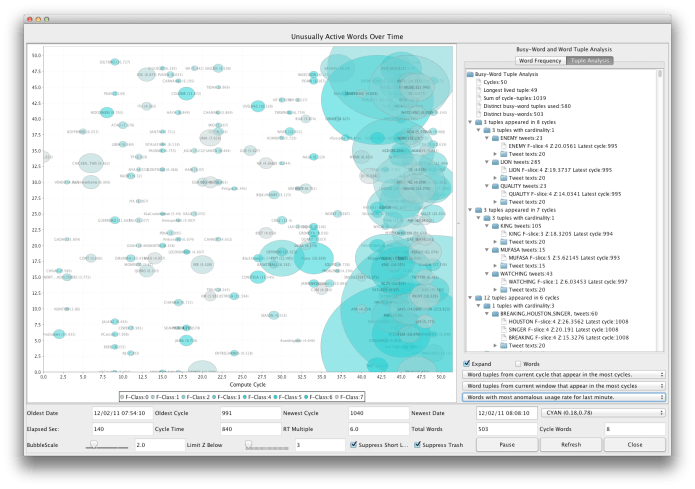
Z-Filters: Listening to a Million Voices

Z-Filters is a technique for listening to what millions of people are talking about.

If a hundred million people were to talk about a hundred million different things, making sense of it would be hopeless, but that’s not the way society operates. The number of things that a million people are talking about in a public forum at any given moment is much, much smaller—thousands, not millions—and by limiting the results to subjects that are newly emerging or newly active, a comprehensive view of what’s new can be seen at approximately the data-flow of the Times Square news ticker.

bubble-view.png Continue reading

Standard
Uncategorized

Erasure Code in Hadoop

What is Erasure Code?

Hadoop 2.7 isn’t out yet, but it’s scheduled to include something called “erasure code.”  What the heck is that, you ask? Here’s a quick preview.

300px-Office-pink-erasers

The short answer is that erasure code is another name for Reed-Solomon error-correcting codes, which will be used in Hadoop 3.0 as an alternative to brute-force triple replication. This new feature is intended to provide high data availability while using much less disk space.

The longer answer follows.

Continue reading

Standard
Hadoop, Hadoop Hive

Lipwig for Hive Is The Greatest!

Making_Money_LipwigOk, this is the coolest thing this Hive user has seen all day.

As you probably know, if you prepend the word EXPLAIN to your SQL query and then run it, Hive prints out a text description of the query plan. This lets you explore the effects such variations as code changes, the use of analyze, turning on/off the cost-based optimizer (CBO), and so on. It’s an essential tool for optimizing Hive.

The output of EXPLAIN is far from pretty, but fortunately, a simple pipeline of Linux commands can give you a slick graphical rendition like the one below.

Continue reading

Standard