algorithms, data science, not-hadoop, twitter, Uncategorized

AI Needs a Better Acronym*

A team at METR Research recently did a study of the effectiveness of AI in software development and got some very surprising results.  At the risk of oversimplifying, they report that the developers they studied were significantly slower when using AI, and moreover, tended not to recognize that fact.

METR’s summary of the paper runs to multiple pages–the full paper is longer–so a couple of lines here can’t really do it justice, but the developers on average had expected AI to speed them up by about 24%, and estimated after doing the tasks that using AI had sped them up by about 20%. In fact, on average, it had taken them about 19% longer to solve problems using AI than it did using just their unadorned skills.

My statistics days are behind me, but the work looked to be of high quality, and the people at METR seem to know how do do a study.  Surprising though the result may be, the numbers are the numbers.

Yikes! How Can That Be?

Superficially, METR’s results seem wildly at odds with my experience using AI for coding. I used it for a month, and felt that it vastly increased my output, not by a double digit percentage, but by a large factor. Four times? Five times? More? It’s impossible to know for sure, but a lot.

Yet, after reading the study more carefully, not only did it begin to seem like a dog-bites-man story, I came to feel that their results strongly validate my own experience and understanding of AI. If you take the message to be, “AI doesn’t make developers faster“, you are probably missing the point.

(Don’t take my one paragraph summary too seriously. METR’s summary can can be seen here. The full study can also be reached from within that page.)

Continue reading
Standard
Uncategorized

AI Programming Part 2: The Particulars

Part one of of this article is about AI programming at a high level and where it might take us. This second part is about the practical lessons I learned in using it. Read this piece, take all of my advice as gospel, and by the end of the article, you’ll be an expert too.1

If you didn’t catch part one, I used AI to rewrite in Go a program that I wrote by hand in Java more than ten years ago. The project comprises about 15,000 lines of Go, plus another 5,000 lines of Python, JavaScript, and shell scripts. It took two weeks and change to write using AI, a small fraction of the time it took to hand-write the original.

The program does a simple thing very fast: it reads the X (formerly Twitter) firehose and extracts the newly emerging subjects. It does this on up to about 8,000 Tweets/second when reading from RabbitMQ, and at about 50,000 Tweets/second reading directly from disk files.

This program makes a good test project for using AI because of its diversity. It’s a high-performance program with lots of concurrency, lots of disk reads and writes, text parsing, tokenizing, some intense algorithmic processing, some esoteric graphing libraries, and a simple Web front end.

Continue reading
Standard
Uncategorized

AI Programming, Part 1

This is the first of two essays about programming with AI. Part two can be found here.

I recently used Cursor to rewrite in Golang a substantial program that I first wrote in Java more than a decade ago. It took two weeks to write it using AI, and since then I’ve messed with it casually, adding some features and making minor changes.

The effort went very well. Cursor informs me that the new version comprises 15,460 lines of Go, 992 lines of Python, 1584 lines of shell scripts, and 3842 lines of HTML and JavaScript. That’s 20,557 lines written in a long couple of weeks, plus documentation and a manual.

That’s a lot of code in very short time, and the throughput of the resulting program is an order of magnitude greater than the original.

Given that level of productivity, it’s easy to see why undergraduates are voting with their feet, running from Computer Science programs like they are plague wards. Unsurprisingly, the old Unix geezers snort at the idea that AI could ever program anything meaningful, goddammit. But so what–those guys snort at everything.

I think both opinions are wrong. The truth is more complex and more hopeful.

Continue reading
Standard
Uncategorized

A Pilgrim’s Progress #4: Panda Series

This is the fourth in a series of posts charting the progress of a programmer starting out in data science. The first post is A Pilgrim’s Progress #1: Starting Data Science. The previous post is A Pilgrim’s Progress #3: NumPy

I’m trying something new out here. These posts are coded in Jupyter which is an extremely handy way to intermingle text and executable code. It comes with Anaconda, which is the best way to get everything going if you’re starting out. For the first couple I cut-and-pasted the material over to WordPress. This time I downloaded the Jupyter file as HTML and pasted it in. Far from perfect but 100x faster. It’s painful to edit once pasted in, so it’s far from a perfect solution. Any ideas?

Pandas are insanely versatile and capable of far more than I’ve covered in this already excessively long set of notes. At best this is a way to get an idea of how they work and a quick tour of what they look like in use.

Continue reading
Standard
Uncategorized

A Pilgrim’s Progress #3: NumPy

This is the third in a series of posts charting the progress of a programmer starting out in data science. The first post is A Pilgrim’s Progress #1: Starting Data Science. The previous post is A Pilgrim’s Progress #2: The Data Science Tool Kit.

What Is NumPy?

NumPy is a library of high-performance arrays for Python. After this I’m going to mostly call it numpy because that’s the name of the package you import. Whatever we call it, numpy supports creating and manipulating arrays of any number of dimensions and the ability to easily reshape them and slice them in complex ways on the fly.

The elements of any numpy array can be accessed in a variety of ways. You can access single elements, of course, but there is a powerful syntax for accessing all sorts of rectilinear slices in one or more dimensions. We’ll look at some of that below.

As the name implies, numpy is designed to support mathematical computing, and is thus packed with convenient features for operating on data as an array or matrix.

Every programmer is used to iterating over the elements of an array using a loop or an iterator, which is a concept that is easily extended to using nested loops to iterate over multi-dimensional structures. Numpy takes a higher-level approach, emphasizing applying operations to an entire array, rather than merely using an array as a repository for data that will be explicitly operated on by loops in your code. Functionally, the two approaches are of equal power–there’s still a loop going on within numpy, but in practice, applying functions to data structures results in simpler, cleaner code that’s easier to understand. The way I look at it is, code you don’t have to write has the fewest bugs, so the less code the better.

Continue reading
Standard
algorithms, data science, data science career, Hadoop, machine learning, Uncategorized

A Pilgrim’s Progress #2: The Data Science Tool Kit

The is the second post about becoming a computer scientist after a career in software engineering. The first part may be found here.

Only a student would think that software developers mostly write computer programs. Coding is a blast–it’s why you get into the field–but the great majority of professional programming time isn’t spent coding. It goes into the processes and tools that allow humans to work together, such a version control and Agile procedures; maintenance; testing and bug fixing; requirements gathering, and documentation. It’s hard to say where writing interesting code is on that list. Probably not third place. Fourth or fifth perhaps?

Linear PCA v nonlinear Principle Manifolds Андрей Зиновьев=Andrei Zinovyev

Fred Brooks famously showed that the human time that goes into a line of code is inversely-quadratic in the size of the project (I’m paraphrasing outrageously.) Coding gets the glory, but virtually all of the significant advances in software engineering since Brooks wrote in the mid-1970’s have actually been in the technology and management techniques for orchestrating the efforts of dozens or even hundreds of people to cooperatively to write a mass of code that might have the size and complexity of War and Peace. That is, if War and Peace were first released as a few chapters, and had to continue to make sense as the remaining 361 chapters come out over a period of many months or even years. Actually, War and Peace runs about half a million words, or 50,000 lines, which would make it quite a modest piece of software. In comparison, the latest Fedora Linux release has 206 million lines of code. A typical modern car might have 150 million. MacOS has 85 million. In the 1970’s four million lines was an immense program.

Continue reading
Standard
Uncategorized

A Pilgrim’s Progress #1: Starting Data Science

This is the first of what I hope will be a series of many posts documenting a pilgrim’s progress from programming to data science.

First of all, let’s talk about the name. It is almost a rule that anything called <something>-science isn’t a science and that will hold here. Science is defined as “an intellectual and practical activity encompassing the systematic study of the structure and behavior of the physical and natural world through observation and experiment.”

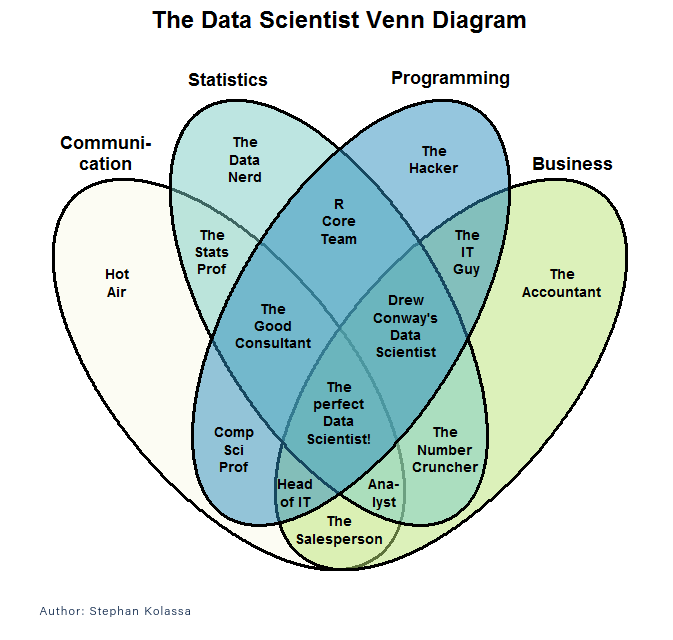
Nothing about data science fits that definition. It’s in the same boat with disciplines like library science, political science, management science, rocket science, and computer science that use mathematics and/or science to do interesting things but aren’t science themselves.

While the sciences study the world itself, data science studies the techniques for understanding the world through data. Data science is applied to some concrete field, be it science, politics, or advertising, but you wouldn’t say it’s “advertising science.” Of course not–it is its own thing. Trying to fit it in under the heading of science is what philosophers call a category error, like considering the manufacturing of firearms to be branch of wildlife management.

Continue reading
Standard
Uncategorized

Not A Review: System76

I don’t usually do product reviews. Not that I’m against them, but this isn’t that kind of blog. I don’t buy or use a wide enough variety of computing equipment to have a valuable opinion. The truth is, as long as my personal computer is fast enough, I don’t have much reason to care about the nuances of processor tradeoffs, bus speeds, and the subtleties of graphics cards. Developing code actually isn’t very demanding in terms of hardware and when the code I write is deployed, it’s usually on swarms of anonymous generic servers managed by people I’ve never met.

What does matter at all levels is the operating system. The OS is the real computer. From inside a computer program you normally cannot see the hardware (unless you’re in a very esoteric field of programming.) All your code sees is the pretty face the OS puts on it. Still less can a user see the hardware. As long as there’s plenty of CPU and disk, the main thing you are aware of is the windowing system and the terminals. You occasionally have to do things that look like they involve hardware, like mounting disks, but even then, what you see is a layers-deep idealization provided by the operating system.

Continue reading
Standard
Uncategorized

Go Go Go

I’m new to Go—just a few months in. I’ve spent a lot more time with Java, C++, even Python, but the Gopher is an interesting critter so far.  It’s not just a better version of <your favorite language here>.

Every language is a commitment to a particular way way of looking at programming but rarely more so than with Go, which is often politely described as “opinionated.”

Some Informal History

Go’s ancestor, the C language, which was invented in 1972, spelled the end of the age of assembler for systems programming. In the words of its author, Dennis Ritchie, C is portable assembler. Until C came along, you had to hand-port operating systems and other systems code to each platform you wanted to run on. There weren’t any IDE’s back then—it was just you and your editor.

go-dude

A vast superstructure of software development tooling has evolved since C was young but less of it than one might imagine is about telling machines what to do.

There used to be a thing called “the software crisis” back in the 80’s and 90’s. Younger programmers may never have heard of it, but in those days the majority of large projects were said to fail as the size of the problems we faced began to outstrip our ability to write commensurately large software.

Yet today, success is the expectation and only the occasional overblown or ill-conceived project fails  . What happened?

It’s not the languages that have changed—I was a CS student in the late eighties and in the years since I have yet to encounter a significant language feature that did not already exist when I was an undergraduate.

It is tools and management techniques to facilitate people working together that beat down the software crisis, not high-powered syntax.

Widespread adoption of Object Orientation allowed data models of unprecedented size to be developed and managed by large teams as they evolved over time. Open-source created a universe of high-quality computational Lego that let individuals or small teams produce incredibly powerful systems with little more than glue code. Agile and other management practices, powerful source control, documentation, tools like Maven, Jenkins, continuous integration systems, Jira, and of course, Unix for everyone.

These things are all about people, not machines. If you left it up to the machines, they’d write everything in C for portability and they’d skip the tabs or newlines.

Continue reading

Standard
Uncategorized

Haxe

Haxe is a most unusual language. So far, nobody I’ve enthused about it to has heard of it, which is a shame. I’m loving it. But before jumping into it, I want to give you some setup.

We had a problem. The company I’m with wants to flush data from hundreds of different kinds of IoT devices to the AWS Cloud. There are also Linux-powered gateways, a ton of code on the Cloud side plus Web browser applications. Among them, they use Python, C/C++, Java, JS, and PHP, and run on Linux, Mongoose, Microsoft, OSX, Android and even bare metal (the embedded controller-based devices, e.g. Arduino and ESP32, etc.)

Despite all these exotica, our problem is humble.  The messages the components send, at some point, are almost all represented in JSON, so we need some way to define that JSON centrally to ensure that all participants conform to the same schema and to make it testable. The best way to do this is to provide developers with standard objects—beans, in the Java world—that emit and accept the JSON.   But we don’t want to write and maintain the bean code in five languages as things evolve. How do we get around that?

Continue reading

Standard