
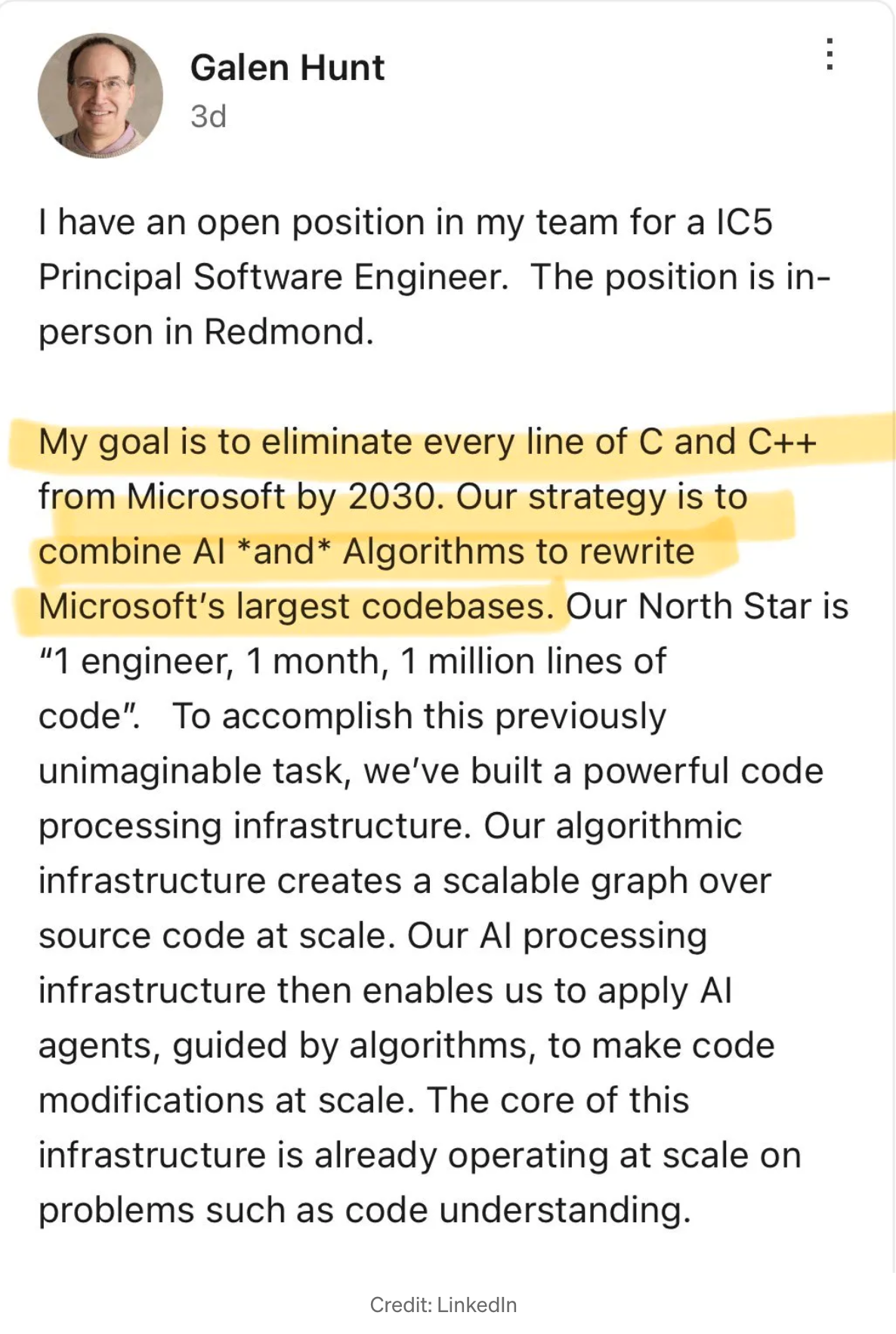
Galen Hunt of Microsoft is assembling a team right now to rewrite their entire product suite, which is currently written in C and C++, by 2030. The stated goal is to code at the rate of a million lines per month per engineer.
Don’t laugh—the goal may be extremely ambitious, but it isn’t obviously insane. There are quantifiable reasons why Mr. Hunt might not be bonkers.
The reasons take some explaining.
The State of The Art
There are still some old Unix geezers who swear AI is an over-hyped fad. Emacs was good enough for Dad and it’s good enough for me, goddammit.

But I used AI on a major (for me) project, and I’m here to testify that it blows human developers out of the water. Using AI, I wrote 30k lines of highly effective code in a couple of weeks or so. That was six human months ago, while AI advances in dog-years. I’m reliably informed that the project would go even faster now.
Even today, almost all of what interns, junior, and mid-level developers do, AI does better, and it’s rapidly squeezing out even the top coders. In the time it takes to explain to a human what you want done, you can write it as a prompt. Less time, actually. A lot less, because AI is incredibly good at inferring what you want and filling in the gaps in your half-baked prompts. And the code is written in seconds, along with unit tests, test data, etc.
While I was typing the forgoing paragraph on Wednesday, a superb developer I know texted me: “I don’t write code anymore. I’ve made 30+ PRs since Monday, and I’ve read about 0.1% of the content.” This wasn’t some idiot—the guy is a master at what he does, a hands-on leader of multiple teams at a technologically sophisticated company.
You get the code in seconds, yes, but surprisingly, in big projects, the value is not just that it writes code incredibly quickly—there are deeper reasons.
Because AI is a tool and not a brain (at least for now) you still need people with deep understanding to define the tasks AI executes. What I’d call that whiteboard work; it’s not exactly programming, but it’s definitely not nothing. More on this later.
Management is having a field day—why should they hire anyone, or even to retain much of the existing coding staff now that AI is in the picture? Nine tenths of programming jobs are dead on their feet right now—they are only still standing because it takes a while for organizations to catch up and for technology people to learn to use it effectively. For my own part, I don’t see why I would ever hand-write another function call in any language, unless maybe for fun, like doing a crossword puzzle.
The Tar Pit Revisited
Paradoxically, the incredible increase in programming effectiveness that I experienced is not the fast part of the power boost from AI that people like Galen Hunt are chasing for mega projects.
The reason is somewhat subtle—a little history first.
Before most of today’s programmers were born, there was a thing called the “software crisis.” In the 1970’s, software engineering had not yet caught up to the advancing power of machines. Programming was rapidly leaving the strictly batch, punch-card, mainframe era behind, and program sizes were exploding. The crisis was that the majority of large projects were failing and ended up abandoned uncompleted. The chronic failure to deliver software had become a major problem in developed world economies.
Fred Brooks, in his classic and still readable, “The Mythical Man Month” (1975), explained why. His argument boils down to a claim that large programs fail because the number of human interactions among members of a team increases quadratically with the number of programmers. In large teams, communication overhead overwhelms actual programming. One consequence is, in Brooks’ famous words, “Adding programmers to a late project makes it later.”

The reason is that attempting to go faster by adding programmers is a linear process, but it results in a quadratic increase in time that must be spent coordinating everyone’s work.
Today, we no longer hear the phrase “software crisis.” The eventual solution was the development of a culture of programming that learned to write software in smaller, minimally coupled units that were defined only by their interfaces. Programmer’s tools improved too—IDEs, higher-level languages and better debuggers, networking, etc.—but basically, we learned to write smaller programs that talk to each other.
That’s one way to say it, but you could argue that it’s backward in that it mistakes the means for the end. Minimizing the number of programmers on a project was the essence; smaller programs was only a means to that end. Reducing the number of lines to write and writing code faster give a linear speedup, but shrinking a team results in a quadratic speedup in the effectiveness of each programmer.
Where The Real Speed Comes From
It took a while to get to the punch line, but it’s this: for realistic AI speedups and team sizes, one programmer who is S times faster because of AI can often beat a team of M programmers who don’t use AI, even when M is larger than S.
In English, that means that the advantage conferred by AI isn’t limited to the speedup factor if using AI lets you reduce the number of programmers.
The advantage is equal to the speedup when comparing one AI powered programmer to one unaided human programmer. That’s what “speedup” means. But AI’s inhuman ability to keep stuff in its mechanical head allows one programmer to cover the same or even greater project territory than a much larger team of M members could cover without AI. With all of the communications and coordination among M programmers removed, the advantage of the lone programmer over them collectively can be much greater than the speedup rate.
This is not true in every possible case, but it’s true over realistic ranges with big teams. In fact, we’ll see below that as long as the AI speedup factor is positive, if the communications cost scales superlinearly, there is always a team size for which a lone AI-powered programmer will beat it, because communications overhead can bring a large enough team to a standstill.
A Real Life Example
When writing that 30k program mentioned above, I was producing about 2000 lines a day of decently structured, readable code that could pass for human written. If I’m honest, the AI code was better than my hand-written code usually is.
Critically, there was exactly one programmer working on the project.
If there had been two of us, I’m confident that productivity would not have doubled to 4k lines per day. It probably would have been more like 3k lines/day, because of the added inter-human coordination overhead.
This is a seat of the pants estimate, but my intuition is that if there’d been five people on the team, the lines/day would have been no better than me working alone.
Theoretically, with enough programmers, the project never would have been completed at all.
More Mathematically
Let’s assume that AI can speed up the coding output of a single programmer by a factor of S, S>1. To keep things realistic and intuitive, let’s say that S is 10x.
Call the average number of developers working on a project M and let’s say in this one case, M happens to also be 10. That means our lone AI person can now rewrite the entire project as fast as the M programmers did the first time. Right?
Wrong! It’s what we said above–the factor of S is how much AI speeds up one programmer.
Greatly simplifying by assuming that every team member talks to every other, the cost of communication in a team of size M grows with kM(M-1)/2, where k ∈ (0, 1) is a fudge-factor expressing the cost of a unit of communication between team members. It’s not an exact formula, but it’s the right kind of curve, and we’ll see below that the values don’t really matter to the basic principle.
Speedup = S / [M – k·M(M-1)/2] Which is equivalent to:
Speedup = S / [M(1 – k(M-1)/2)]
Speedup is greater than one, i.e., a single AI programmer beats M unassisted programmers, i.e., when the numerator exceeds the denominator:
S > M - k·M(M-1)/2
Or equivalently when:
S > M(1 – k(M-1)/2)What this is saying is
- As the cost of communication goes to 0, the AI speedup required for one AI developer to equal a team of M developers approaches M.
- If communication has a cost greater than zero, as it always does, the communication overhead eats into the productivity of the M programmers at a rate that increases quadratic in M.
- As long as S≥1 there is always a maximum team size team beyond which the lone AI programmer will progress faster than the team.
And at the risk of pushing the model too far, note that if k, the cost of a unit of communication, is too big, S becomes negative for teams larger than one. Taken literally, it means that beyond a certain size, adding more team members actually causes progress to be negative, i.e., the project loses ground. That seems descriptive of reality to me, but if that interpretation seems too fanciful, we can see below that the denominator actually does stay positive for a realistic range of values.
The denominator M(1 – k(M-1)/2) goes negative at M > 1 + 2/k.
We see that halving k doubles the critical team size, so k and the maximum productive team size have has a pure inverse relationship. The 1 is negligible at these scales so it’s approximately just 2/k throughout.
By the formula above, the maximum productive team size for various k values is:
    k = 0.1 → goes negative when M > 21
    k = 0.05 → goes negative when M > 41
    k = 0.01 → goes negative when M > 201
For Example
This is a fairly realistic case. At team of 10 programmers versus a single programmer who is speeded up to 10x by AI. Communication cost is a tenth of a unit.
Say S=10, M=10, k=0.1:
Team output = 10 – 0.1·45 = 5.5
One AI programmer = 10
Effective speedup = 10/5.5 = 1.82
So the lone programmer is 1.82x faster than the whole team of 10.
The critical thing here is that none of this depends on either the exact values or the particular cost function used here (kM(M-1)/2). Any superlinear communication cost function would produce a similar relationship so long as k>0 and S>1. This means it’s a very general principle.
Yet, Management Shouldn’t Be Dancing In The Street
Yippee! Software development is now a solved problem, so we can all go home, right?
Not exactly, because producing software isn’t all programming.
AI may indeed take over most of the coding work. Not may—it surely will. In some places, it already has, but just as a programmer’s life isn’t mostly coding, the total staff that brings software into the world and keeps it there isn’t mostly programmers. Not by a long shot. All kinds of other people are involved, including stakeholders, managers, testers, system administrators, deployment experts, cloud engineers, QA staff, product owners, designers, marketing people, business people, sales teams, building maintenance personnel, receptionists, etc.
I have not found good numbers on this, but anyone who has been in the industry can see that the people actually checking code into source-control are a minority in a business of any significant size. And that brings us to the most consistently disappointing principle in all of software engineering.
Amdahl’s Law
Amdahl’s famous law applies to optimizations to speed up a program. It is a mathematical expression of the simple idea that no matter how much you optimize some portion of a program, the maximum speedup to the entire system is capped by the proportion of the computing that takes place in the chunk you optimized. It’s obvious as soon as it’s pointed out.
Imagine that your compute-intense program spends three quarters of it’s time in a hardcore 5% of the code. No matter how radically you optimize that critical 5% of the code, you cannot speed up the total program by more than 4x. The general formula follows.
If P is the time you spend in the relevant part of the process, and you speed P up by S:
Speedup = 1 / ((1 - P) + P/S)If you speed up the busy 5% by a big but still plausible factor, say, 10x
Speedup = 1 / (0.25 + 0.75/10) = 1 / (0.25 + 0.075) = 1 / 0.325 = 3.07At 10x speedup, we only tripled the overall speed. Not encouraging. If the speedup that applies to P goes to infinity, the second term in the denominator disappears, yet the total speedup only increases a little more.
Speedup = 1 / (1 - 0.75) = 1 / 0.25 = 4xThis cruel principle has broken programmer hearts for decades. Optimizing even the most critical code is often disappointing. (Algorithmic changes are another story!)
We usually think of Amdahl’s Law as applying to software, but the general principle can be applied to other systems as well, albeit maybe not as rigorously.
The idea can be applied to the whole software development process. Speeding up one part of the process usually can only do so much. The argument for the high-level economic effectiveness of sacking the development staff depends not only on how much AI speeds up coding, but on how much of the total process coding constitutes today.
I’m sure you see where this is going.
Let’s say the actual programming is 25% of the software development process. And let’s say that AI produces a 10x increase in the productivity per developer. And further, let’s say à la Brooks that the radical decrease in team size results in another 10x, for an overall 100x speed increase for development. Plugging these values into the equation we see:
Speedup = 1 / ((1 – 0.25) + 0.25/100) = 1 / (0.75 + 0.0025) = 1 / 0.7525 = 1.329x
In other words, even when coding is almost infinitely fast, software only goes out the door 1/3 faster.
Is That Fair?
Who knows? It might be more than fair.
Amdahl’s law isn’t really a law–they call it that because Amdahl’s Rule of Thumb sounds lame.
This is because the formula only holds when the steps inside the chunk you are speeding up are independent, and often they are not. That section inside the main loop that you optimize the hell out of might be producing work that is done outside itself but inside the driving loop. Not every kind of work scales easily and suddenly that work outside the busy section is arriving 10x faster. Interactions with networks, databases, and disk–all kinds of things can have inconvenient non-linear effects and surprising interactions that only show up when you make something else a lot faster.
Another real-world situation is that even if that hyper-busy code is optimized to the nines, it doesn’t mean much if the overall progress of the program is tied to something unrelated. If the result is used on a schedule it can be a case of hurry up and wait.
It is the same when you apply Amdahl’s Rule of Thumb to a business process. The coding part of the software cycle isn’t independent of the rest of the components, nor are the rest of the components independent of the coding. There is a tremendous amount of friction both ways and what little remains of the miraculous speedup of the 25% can be lost in friction and the inertia of the other 75%.
The Pipeline Problem
Still, assuming the benefits of the speedup are realized, 1.329 faster is a significant speedup, and dumping an expensive 0.25 of the staff is nothing to sneeze at in dollar terms.
The problem is that senior developers constitute priceless intellectual capital because they not only understand the technology underlying a complex product, they understand where that product fits in world, and equally importantly, they have a feel for the new world that is coming down the pike. They are also driven by emotion to think deeply about the purpose of what they are doing, and how to move a massive software business into the future.
And senior people were junior people first.
These things that make these senior people valuable are mostly outside of what AI handles well. But what the interns and the junior and mid-level devs do is exactly AI’s wheelhouse. Cutting off the junior-to-senior software engineer pipeline is a bit like the medical world realizing it can save a lot of money by dispensing with interns and residents and letting AI handle all the routine cases. It’s true that you would save a ton of money for a while, but where would the next generation of attending physicians come from?
The truly senior people rarely do a lot of coding. Why would they? Architects of buildings don’t lay brick. Automotive engineers don’t run screw guns on the factory floor. What they know is what matters, and what they know is still generally beyond the scope of AI, and contrary to hype, AI coverage of it does not seem to be immediately on the horizon.
It’s Not the First Time We’ve Been Down This Road
The situation we will face is similar to the mistake we in the US made with manufacturing over the last several decades, as manufacturing companies moved production offshore to cut costs. That massive offshoring indeed saved a ton of money, but when you offshore the making of things, you also offshore a tremendous amount of knowledge with it.
Those kinds of skills don’t go extinct overnight. There is a lot of inertia in the system, but in a couple of decades the people with the high-end skills age out and they are no longer replaced from below.

The current administration is making a quixotic rearguard attempt to “bring back industry” by using tariffs to make domestic manufacture more competitive.
It’s an appealing idea, but the chain of industrial engineering and highly skilled crafts that had developed continuously since the early 19th Century was severed two generations ago when we abandoned most manufacturing. Those folks aren’t there anymore.
We originally outsourced to China because Chinese labor was cheap. Today, Chinese labor is not that cheap anymore, but we continue to go to China anyway because after forty years of China being the world’s biggest manufacturing center, that’s where the advanced know-how is. Today, we quite literally could not onshore large categories of manufacturing no matter what because we no longer have the tool-and-die makers, mold-makers, and engineers. We don’t even have enough of them to train up new people. It would be a multi-generation project to redevelop the expertise, just as it took China generations to develop the insanely deep bench of expertise they presently enjoy.
In other words, when we sent manufacturing overseas we deracinated the higher-level fields of industrial design and product engineering. It says on the packaging that your phone was designed in Cupertino, but is it really designed domestically when the myriad details inside the case can only be designed in Shenzhen, where they actually know how to make it?
What We Face
The radical elimination of programming and software engineering jobs is probably inevitable. The power of AI is just too great, and it comes with some enormous short term side-benefits, particularly in its democratization of the capability to write useful software.
Yet, just as with manufacturing, we are facing a “tragedy of the commons” situation. It is to every manager and CEO’s immediate benefit to use AI to slash development costs to the bone, and to the economic and career benefit every developer of AI to provide the tools to do it, yet it is probably to society’s collective long-term disadvantage, because when we “offshore” software development to AI, we risk cutting off the wellspring of creativity that fuels the engine of progress.
As with offshoring manufacturing, offloading software development to machines is essentially cashing out intellectual capital, rather than allowing it to slowly compound.
The negative effects won’t be felt immediately. Tens of thousands of top people won’t vanish overnight. But already young people are fleeing computer science programs in droves because they correctly assess it as a dead-end career path. But it won’t be just the rank-and-file developers who fly—the brilliant will also seek more greener fields.
The upside is that ordinary people will be able to afford housing in the Bay Area and in Redmond again.

